sharper, as richness in overtones increases (in view of the frequency range and the intensity of the upper frequency components) (von Bismarck, 1974)175 . For low tones, rich in overtones, the dense partial sequence in the upper frequency region leads to a rough character. This effect can occur for tones from the 3rd octave upward. While, for example, for G3, overtones above 2,000 Hz effect a roughness, the corresponding limit for G1 already lies at about 500 Hz (Terhardt, 1974)176 . In contrast, overtone- poor sounds have a tendency for dark or soft timbre.177
The harmonic series178 orders the particular series of partial frequencies of a composite tone. They are numbered similarly to the harmonic series though a composite tone does not necessarily contain each partial of a harmonic series. An illustration of the harmonic series starting at a fundamental frequency is therefore a useful model when analysing the interactions of particular upper partials (prt.) above the pitch of fundamental frequency (Fnd.) within a composite tone.The intervallic description, i.e. P5- perfect 5th, M3 – major 3rd denote the distance of pitch above the fundamental pitch. These intervallic descriptions are useful for identifying a particular partial tone aurally.
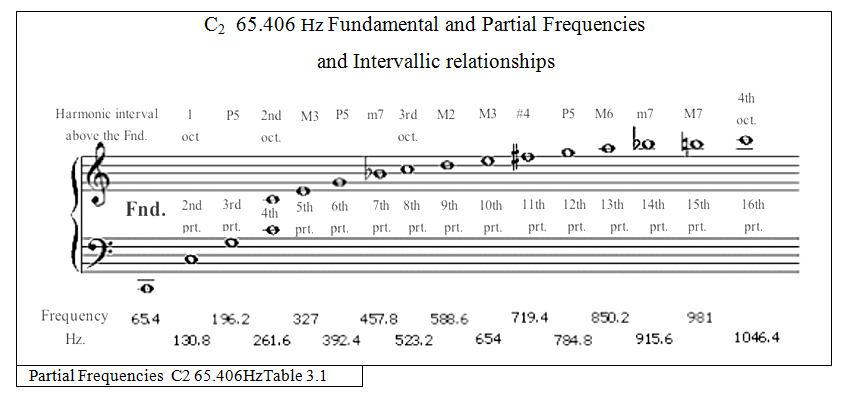
The partial frequencies in piano notes are not as perfectly harmonic as in figure 3.1, that is, not an exact whole- number frequency relationship to the fundamental frequency. Due to adjustments of temperament, the stiffness of high tension steel wire, the movement between horizontal and vertical vibrational plane of piano strings, and the impedance qualities of the wooden bridge, the in harmonicity of partial tones is an accepted ingredient of the piano tonal spectra. This was proven by Fletcher and Blackham in their well documented experiment conducted at Brigham University in the 1960s.179 The harmonic partial frequencies for each of the notes examined in this research are presented in table in Appendix 3.Table 3a.1.
175 Bismarck, G.von, Timbre of Steady Sounds: A Factorial Investigation of Its Verbal Attributes, Acusticaunited with Acustica Vol.30, (March, 1974) :146-159,http://www.ingentaconnect.com/content/dav/aaua/1974/00000030/00000003/art00005
176Enrst Terhardt, On the Perception of Periodic Sound fluctuations (Roughness), Acta Acustica united with Acustica, 30(4), (April, 1974) ; 201-213.
177 3Meyer,30.
178Reginald Bain, The Harmonic Series,University of South Carolina, 1st April, 2003 http://in.music.sc.edu/fs/bain/atmi02/hs/index-audio.html (accessed July 2012)
179 Fletcher,H. & Blackham,D.E. & Stratton R. “Quality Of Piano Tones” The Physics Of Music, readings fromScientific American, New York: W.H. Freedman and Company, 27, 1963.