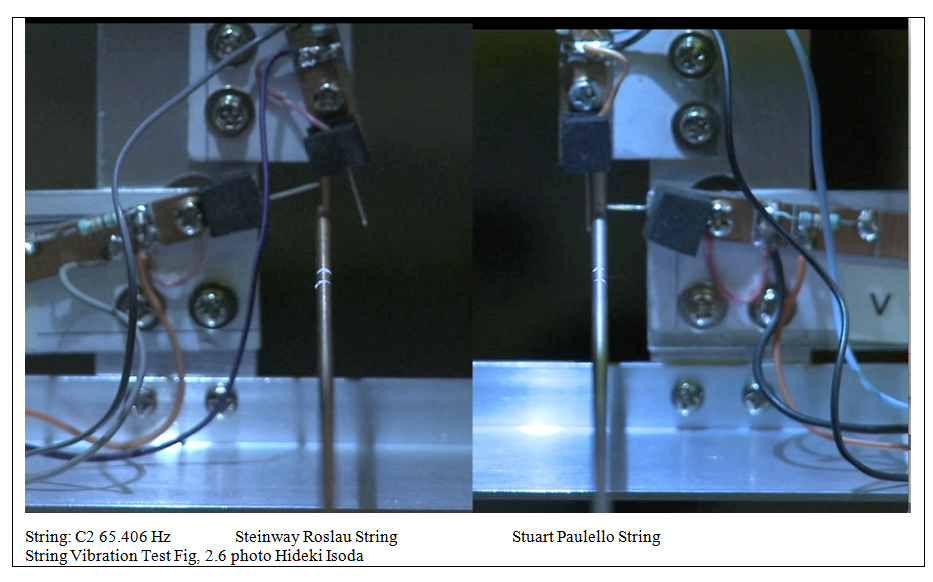
Visual Observations of the String Motion:
The Stuart-Paulello string moves in a more controlled manner than the Roslau-Ste in way string. At the initial strike, or onset, the Stuart string does appear to move further and more frequently in the up-down direction though it is not completely clear. After 12 seconds, the movements of the strings are distinctly different. The Stuart-Paulello string exhibits a more controlled movement with less variation of direction than the Roslau-Steinway string. The filming exercise was a great success in illustrating the contrasting string vibrations, and confirmed that the coupling affected the vibration. The Stuart agraffe does appear to be controlling the string vibration.
The precise behaviour of the string oscillation when struck by various levels of force was tested and measured by Peter Phillips. Using the same string apparatus and electronic striker, Phillips assembled electrical sensors and positioned the sensors very close to the strings to record the exact vertical and horizontal vibrational movement of both strings, as they oscillated after being struck by various levels of force, by the electric striker.
This research is influenced by Gabriel We inriech’s study Coupled Piano Strings, which established evidence for the actuality of two polarizations in the piano string motion, vertical and horizontal, with respective decay rates. We inriech constructed a vibration probe for piano strings which recorded the two independent projections of the string’s motion. 162
162 5We inreich. The Coupled Motion Of Piano Strings.