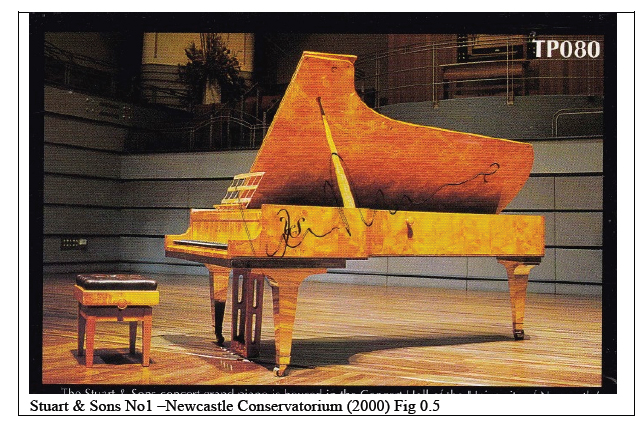
The cabinet is veneered in rare birds eye Huon pine and the legs covered in gold plated brass. The veneer was cut from an ancient Huon pine log salvaged from a creek bed in South West Tasmania. The Surface emulated the oxidised golden appearance this timber adopts when exposed to the air.
These materials were chosen for the first Stuart & Sons piano to portray an image of light and time. Stuart & Sons pianos are designed and individually hand crafted in Australia. They incorporate innovative design principles that enhance dynamic range and sustaining qualities. A unique string coupling system produces exceptional clarity of tone, opening new horizons in piano making and performance technique. Stuart believes that the current limited choice of differing aesthetic qualities in modern musical instruments disadvantages musicians and ultimately leads to a decline in performance standards.The great tradition of western musical instrument making requires constant change to remain vital and relevant. 63
The visually appealing appearance of the Stuart piano and the localised fascination of an Australian piano, made of Australian woods with extra notes and a new sound, created the subject of many arts media stories soon following the launch of the Stuart piano. This public interest in an Australian piano is well founded on the historic successes of Octavius Beale’s piano manufacturing operations, sourcing his timber from the forests of Dorrigo in NSW, early in the twentieth century 64. The Beale and Wertheim names hold a special place in Australian social history, having manufactured many thousands of Australian made pianos for households and schools in the years of the piano popularity boom, early in the twentieth century.
Unlike the Beale and Wertheim instruments made early last century, and indeed most pianos manufactured today, the Stuart & Sons piano is not manufactured by mechanised machines to an economy of scale. Its use of the finest contemporary materials and technologies, and its handcrafting at high expense means that an average of three pianos are made a year. Without a large market demand, the Stuart piano is produced without the requirement to standardize its manufacturing process, enabling the experimental and developmental piano building process to continue. The ongoing developments in
63Ian Munro, CD cover notes Mere Bagatelles,Recorded 1995,Tall Poppies, 1996 compact disc.
64Coffs Harbour Council,“Timber Hydro Mill,” Heritage Division, Office of Environment and Heritage Report on the Timber
Hydro Mill in Tiimmsvale N.S.W. SHI number 1360215, 9th Dec.2014. Heritage Division, Office of Environment and Heritage. http://www.coffsharbour.nsw.gov.au/places-for-living/land use/HeritageSheets/ScheduleListedItems/Timberhydromill(former).pdf