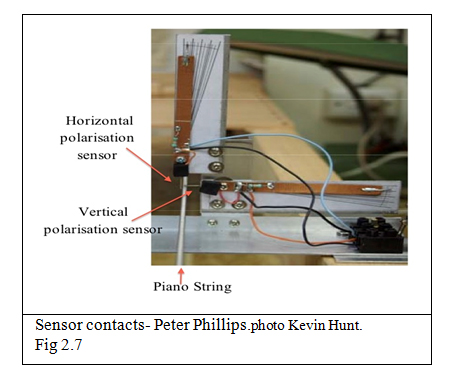
Peter Phillip’s sensor contacts, pictured above, are positioned so that they contact the string when the string reaches a certain distance in both vertical and horizontal directions. The sensors are connected to an oscilloscope, which is set to the periodic time frame of the fundamental 65.406 Hz. Vertical lines are spaced at the period of the fundamental wave form on the oscilloscope, so when each the string vibration is recorded, the measurement of the vibration contour and the cyclic temporal segment of the waveform are lined up in the oscilloscope’s recording of the string movement. 163
Four String Vibration Tests.
Four tests were conducted to precisely measure the horizontal and vertical vibrations of both strings. As observed in the string vibration video on the previous page, the string oscillates in a predominantly vertical, up-down direction immediately after the hammer strike, the onset.
……the vertical polarization is the primary one excited by the hammer, and so begins its life at a much higher amplitude than the horizontal one.164
Phillip’s sensors recorded the magnitudes of the vertical and horizontal excursions of the string oscillations in four tests using varied velocity ranges of the electronic striker.
Test 1. The magnitude of the vertical oscillation in each string-
Result: the Stuart/Paulello string vertical excursions in the oscillation were 2mm larger.
Test 2. The duration of the vertical oscillation in each string-
Result : the duration period of the Stuart/Paulello vertical excursions was longer. Approximately 160ms longer.
Test 3. The magnitude of the horizontal oscillation in each string-
Result: the horizontal excursion in the oscillation of the Steinway/Roslau string was larger.
163 See Appendix 2, for detailed illustrations of the oscilloscope illustrations of the string vibrations.
164 6 We inreich. The Coupled Motion Of Piano Strings.