C2 directivity
M19 (STU) C2 to mic 6; STE C2 to mic 2
In the MW 3 metre microphone array, across the three velocities, the Stuart piano radiated it’s maximum SPL of the note C2 to mic 6, away from the pianist, in the direction of 180°, and the Steinway radiated maximum SPL of the note to mic 2, 30° off centre, on the side of the pianist.
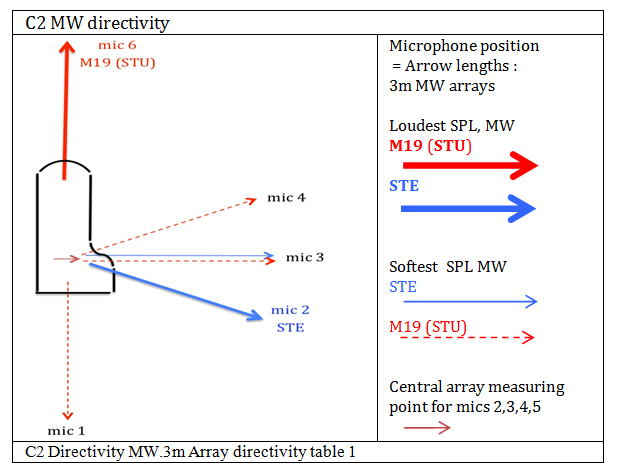
The Stuart piano was the louder instrument across the three velocity strikes, of C2 sounds which travelled 3 metres to mics 2 & 6. The volume levels of both pianos are closer together at mic2.
The factors of string scaling, length, tension, type, yield and coupling are major factors in why the Stuart was significantly louder, as well as a significant difference in the amplitudes of soundboard vibrations. For the note C2, the diameter of the Paulello/Stuart core wire is .125mm thicker, the cover wire is .47mm thicker and is stainless steel247 , the tensile strength of the Paulello/Stuart wire is 481 N/mm² higher, the Paulello/Stuart is 235mm longer, and is set at 65.3kg higher tension. The yield or capacity of the Paulello/Stuart. wire is 46% higher than Steinway/Roslau.
Both instrumental volumes (mic7) were louder in the Steinway sound
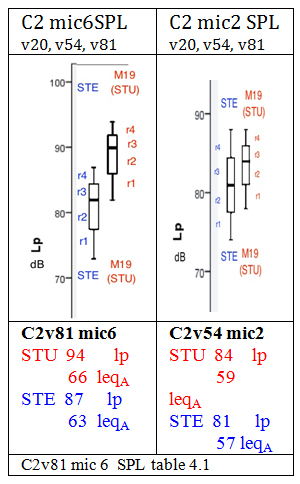
C2v81 MW mic6 ,
Instrument Volume Mic7: STU 92dB , STE 96dB
Soundboard: The Steinway soundboard vibrated a larger Fnd., and the Stuart board vibrated larger vibrations of the rest of the spectrum, 1-10 harmonic frequencies. Overall , the Stuart soundboard vibrated 47% more actively for C2v81.
C2v54 MW mic2.
Instrument Volume Mic7: STU 88dB , STE 89dB
Soundboard: The Steinway soundboard vibrated the Fnd and 3rd prt. as strongly as the Stuart soundboard. Overall, the Stuart soundboard vibrated 44% more actively across the spectrum .
247Stainless steel is 1.9g per cubic cm lighter than copper in specific gravity.
http://www.csgnetwork.com/specificgravmettable.html (accessed July, 2014).