Eight Introductory Sounds of Stuart Piano Tone Distinction.
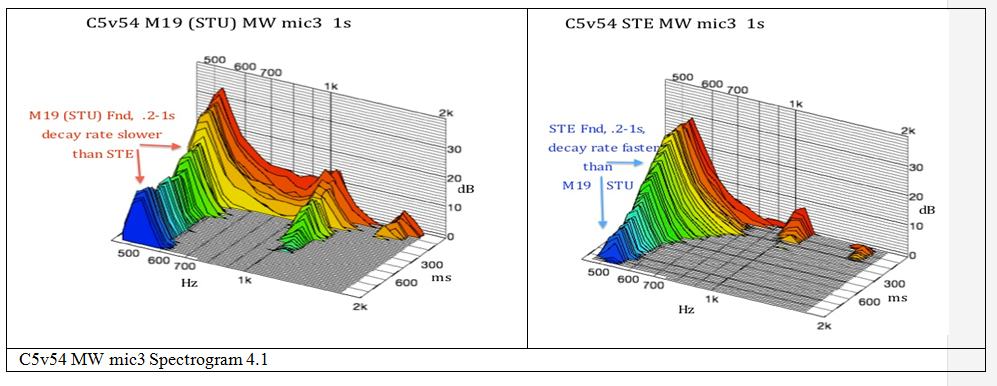
1. C5v54 MW mic3Onset Tonal Stability.; Slower Fnd a-s; Earlier a-s transition.
The Stuart sound is brighter, with more sustain of the onset tonal balance. The Steinway decays immediately and has a rounder tone. The Stuart’s larger Fundamental, 2nd and 3rd partials, contribute to the brighter tone colour.
| Stuart C5v54 M19 (STU) MW mic 3.wav |
Steinway C5v54 STE MW mic3.wav |
| C5v54 mic3 Sound table 4.3 | |
MW array sound:
| Stuart C5v54M19 (STU) MW mxd.wav |
Steinway C5 v54 STE MW mxd .wav |
| Sound table 4.4 C5v54 mixed array | |
The brightness of the Stuart tone at mic3 is enhanced in the room sound of the 8 microphones.
Decay:
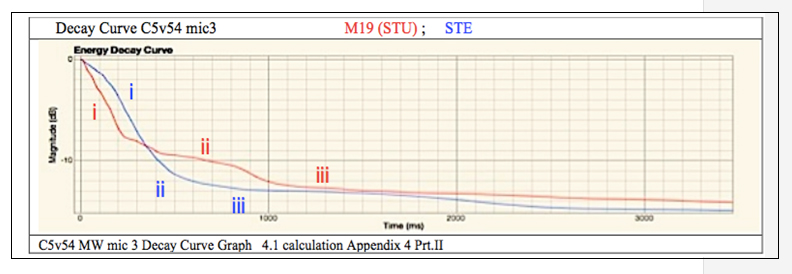
The Stuart sound decayed more rapidly in the onset state (i) for a shorter duration, losing less energy in the onset, with its earlier transition into the 1st phase of the slower settled oscillation (ii), a phase of decay observed as being less significant in the Steinway sound, in this instance.
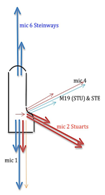 |
Both pianos radiated waves of similar SPL to mic M19 (STU) lp 83 leqA 62 ; STE lp 82 leqA At velocity 54, Stuart radiated waves of its maximum SPL to mic2, and Steinway radiated waves of its maximum SPL to mics 1 & 6. The Stuart sound radiated marginally higher SPL of C5 to mics 2,3,5,7 and significantly higher SPL to mic 8.Soundboard: The magnitude of the movement of the Steinway soundboard was found to be 46% higher than the Stuart soundboard for C5v54. |
| C5523.25Hz Scaling, Soundboard table 4.1 | |