A combination of research practices, the intuitive musical knowledge attained by playing the instrument and the analytical evaluations of its sound production, has achieved my overarching research objective to define distinctive characteristics of the Stuart & Sons piano sound. Four distinctive characteristics of sound quality were found in the Stuart sound:
i) A slower rate of decay in the fundamental partial frequency
ii) An earlier transition into the after-sound states of string oscillation.
iii) A wider harmonic spectrum in the onset state of the sound.
iv) A more comprehensive projection of sound to 6 metres.
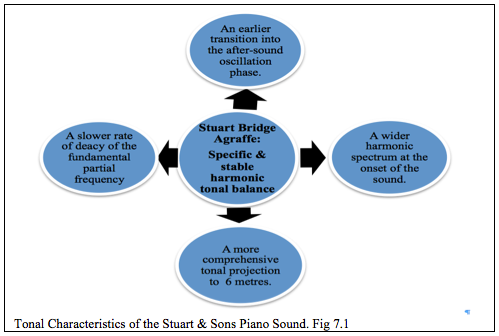
This research has proven that the defining findings of the Stuart piano tonal colour are directly a consequence of the Stuart bridge agraffe. The particular states of oscillation and vibrational behaviour of the Stuart piano strings were found to be a consequence of the manner in which the Stuart bridge agraffe couples the strings to the bridge and soundboard. It is therefore proposed that each Stuart & Sons piano would exhibit tonal characteristics that associate closely to the findings of this research.
To encourage audiences to articulate their perceptions of the Stuart piano sound, I developed a vocabulary of verbal attributes from a wide range of piano literature to present literary descriptions of the Stuart piano sound.
For example,
‘A bright percussive onset sound that decays quickly and briefly to settle into a steady mellow sound of pure clarity.’