C5v81 MW mic6
| Stuart C5v81 M19(STU) MW mic6.wav |
Steinway C5v81 STE MW mic 6.wav |
| Sound table 4.37 | |
The Steinway sound at mic6 is 10dB louder than Stuart, as shown in the spectrogram below, the fundamental of the Steinway is significantly louder and larger in amplitude. The Steinway has a fuller tone. Quite possibly, we are hearing the effect of the larger Fnd. sounded by the Steinway soundboard, and its 44% greater vibration of the harmonic spectrum. The Stuart sound is brighter in tone, at the onset. The spectrogram below shows the 2nd partial frequency of the Stuart sound was louder than the Steinway’s 2nd partial, at the onset, which also corresponds with the vibrations of the Stuart soundboard. The onset periods of Stuart Fnd., 2nd & 3rd partial frequencies are decaying are slower rates to .2s.
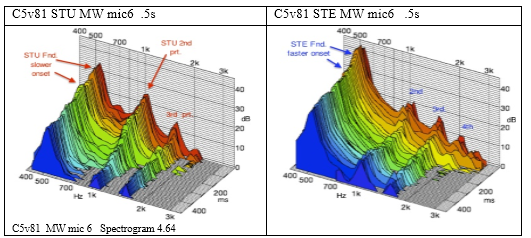
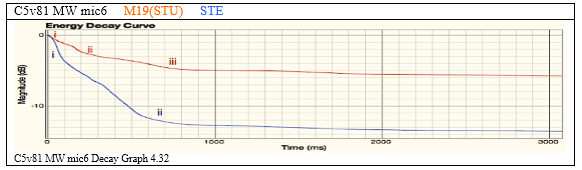
The decay curve below indicates that the Stuart onset oscillation is very rapid (i) , transferring to the steady after-sound oscillation at .2s(ii).The rapid decay of the Steinway onset oscillation (i) continues to .5s in a longer duration than Stuart (i). The Stuart enters its steady oscillation (ii) at .2s, .4s earlier than Steinway, (ii).
Conclusion:
The larger amplitude of the 2nd prt. in the Stuart sound of C5v81 at mics 2& 6, has influenced the brighter tone, and indicates a larger spectrum of upper partials in the onset period of the Stuart sound. The steady oscillation of the Stuart’s after-sound period, occurred earlier in the notes’ durations, at both mics2 & 6. At both microphones, the Stuart fundamental decayed at a slower rate than Steinway before 1s, generating a greater sustain in the sound, especially at mic2, after 4s.