C3 Directivity
C3v81 MW mic1.
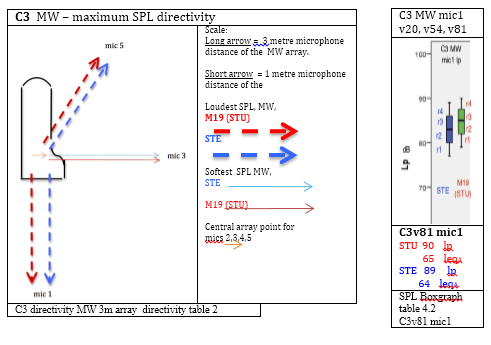
The Stuart & Steinway pianos both radiated maximum SPL of the note C3 to mic 1 & 5 equally, in two opposite directions, mic1 180° to the pianist, and mic5 150° away from the pianist, indicated in by the dashed lines in the graph below. This section examines the C3 sounds radiated to mic1. C3 sounds at mic5 have been discussed in earlier sections of this chapter.
| Stuart C3v81 M19(STU) MW mic1.wav |
Steinway C3v81 STE MW mic1.wav |
| Sound table 4.33 | |
The Stuart sound was marginally louder at mic1 across the three velocity strikes. The Stuart piano was marginally louder than Steinway at mic1, by 1dB. A sudden rise ‘swelling’ in the bass frequency level of the Steinway sound occurs between .5s,- 1s. At this precise time, the Spectrogram below shows a sudden decay occurs in the STE Fnd, an the 2nd prt is continuing a stable rate of decay. The 3rd & 4th STE prts are also decaying at steady rates. The sense of unstable tonal & harmonic movement in the onset, in the Steinway sound, is therefore due to the sudden change in the fundamental level. A high 7th or 14th prt is also prominent in Steinway’s after-sound. The Stuart C3 produces a more balance sound, of increased clarity, without the changing level of the bass frequency. The spectrogram below shows the Stuart fundamental frequency sustains between .3s and 1s, producing a more stable bass frequency. The Stuart sound has a more percussive brighter tone in the onset, due to louder 2nd, 3rd & 4th partials. The 2nd prt. an octave above Fnd., is also more audible in the sound Stuart sound. The 3rd, 4th and 5th partials are more prominent in the Steinway spectrogram below.