The sounds of the note C2 of both pianos, at their strongest directivity SPL radiations, are examined in the following pages. Both sounds C2v81 mic6 and C2v54 mic2, have not previously been discussed. For cross checking levels, C2v81 mic2 was previously discussed on p.122, in the tonal distinction No. 2, ‘Earlier Transition to After-Sound Oscillation.’
1.C2v81 mic6. STU maximum radiation , Stuart tonal distinction 4.
| Stuart C2v81 M19(STU) MW mic6.wav |
Steinway C2v81 STE MW mic6.wav |
| Sound table 4.31 | |
The Stuart bass frequency is more prominent than Steinway’s. A harmonious upper partial is prominently sounding, the P12th above, the Stuart Fnd. which corresponds with the 3rd partial frequency shown to be prominent in the Stuart sound. The Stuart Fnd. is shown below to have decayed at a marginally slower rate than the Steinway Fnd. at both the onset and after-sound oscillations. This slower decay in after-sound oscillation is illustrated in more detail (ii), in the decay curve table 4.26 below. The 3rd, 4th 5th and 6th partials of the Stuart also decayed at a slower rate than Steinway.
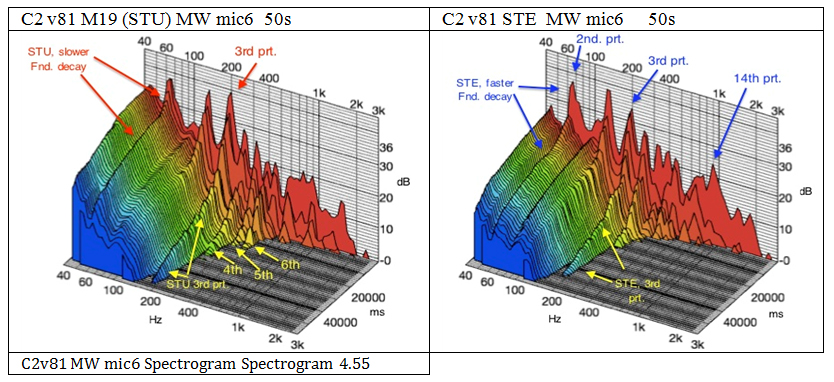
Examining the onset of the note C2 v81, in spectrogram 4.9 below, illustrates graphically what we hear in the more stable, clear, less cluttered beginning of the note, of the Stuart sound. The coloured ‘ridges’ of the partials in the spectrogram, are graphic displays of the SPL dB levels of each individual partial, decaying towards the front, from the peak of the onset on the rear axis. The ‘ridges’ of the Stuart Fnd, 2nd & 3rd partials, are more evenly displayed than the Steinway ridges of the same partials, and the higher ridge of the Stuart 3rd prt. seems to be the strongest of
all the partials, showing very little decay.