Earlier Transition to slower Oscillation Stuart tonal distinction 2.
3. C3v20 MWmic5
| Stuart C3v20 STU MW mic5.wav |
Steinway C3v20 STE MW mic5.wav |
| Sound table 4.25 | |
The Stuart piano radiated its sound at 3dB louder than Steinway to mic5, at velocity 20(v20). The Stuart is louder at the onset, than Steinway. The Steinway bass frequency swells after 1s, and then decays rapidly after 4s. The Stuart sound is more constant from the onset. The 3rd prt. is more prominent in the Stuart after-sound. The 2nd prt. is more prominent in the after sound of the Steinway. The onset oscillation of the Stuart sound (i) , decays at 8.6dB/s, almost twice the speed of Steinway. The Stuart oscillation transfers into the first stage of the after-sound oscillation (ii) after .5s, approximately 2s before the Steinway’s transition. In the first phase of the settled after-sound oscillation (ii), the Stuart sound decays at a slower rate than Steinway after .3s,
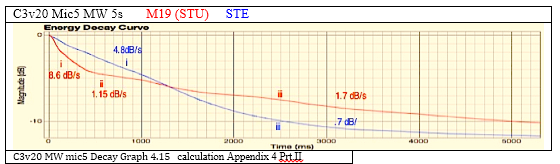
Energy loss-The rapid loss of energy at the onset of the Stuart sound could be due to several factors. The thinner soundboard of the Stuart, vibrated with larger harmonic magnitudes, 31% more than the Steinway soundboard, and therefore is expending 31% more energy, and the vertical coupling is enabling a larger movement of the string at the onset, producing a larger louder string vibration and wider spectra, which decays at a faster rate than a quieter vibration with a narrower spectra.245 The Stuart sound’s rapid restoration back to a settled oscillation at .5s, is the factor which establishes a more stable sense of sustain in the sound.
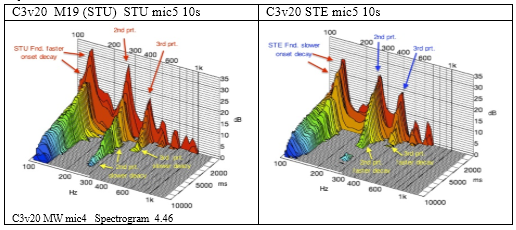
Spectrogram 4ii).7 below, illustrates distinctive qualities of the Stuart’s sound. The fundamental and 2nd partial frequencies are larger in amplitude than Steinway, with faster onset decay and slower after-sound rates of decay. Steinway 3rd partial is larger in amplitude, a higher SPL, and faster after-sound decay.
245 9Roederer,.122.