6. C4v20 MW mic4Slower Fnd. after-sound; Earlier a-s transition
 |
Stuart C4v20 M19(STU) MW mic4.wav |
Steinway C4v20 STE MW mic4.wav |
| Soundtable 4.13 C4v20 MW mic4 | ||
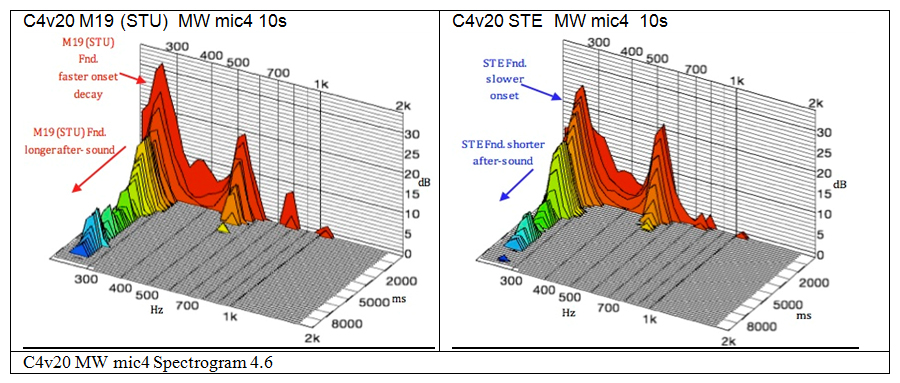
The Stuart sound has a faster attack, a louder fundamental. The Steinway sound diminishes momentarily in the first second.
Array sound :
| Stuart USB Audio 4.0 trk.41 C4v20 STU MW mxd(2).wav |
Steinway USB Audio 4.0 trk.42 C4v20 STE mxd MW (2).wav |
| Soundtable 4.14 C4v20 MW mxd arry | |
Decay:
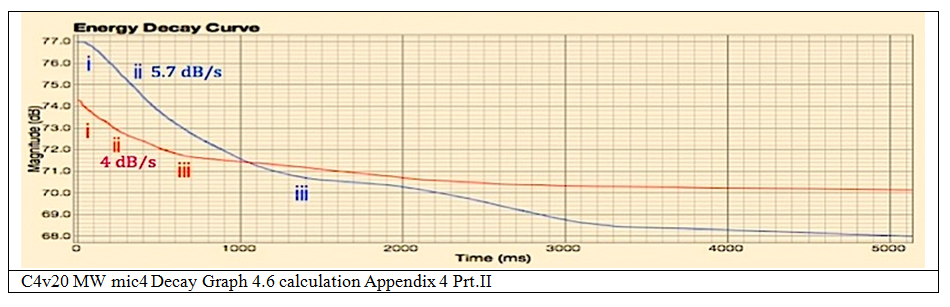
The Steinway note is louder at the onset, it peaks later then STU in the onset, and holds it’s peak for longer, to .3s. (i) it then decays more rapidly than Stuart in the 1st phase of after-sound (ii) , The Stuart transfers to the 2nd phase of after-sound oscillation (iii) earlier, after losing less energy, hence the sense of a more stable sustain.
Soundboard: C4v20 At the 4 probe positions, the Stuart soundboard vibrated at 75% greater magnitude than the Steinway soundboard for C4v20
String Scale: The diameter of the Paulello/Stuart wire is .25mm thicker, the tensile strength of the Paulello/Stuart wire is 177 N/mm² higher, the Paulello/Stuart is 1.5mm longer, and is set at 3.5kg higher tension. The yield or capacity of the Roslau/Steinway wire is 3.6% higher than Paulello/Stuart.
A faster after-sound decay decrescendo is audible in the Steinway sound, from approximately 1s, immediately after the bass frequency ‘swell’ crescendo. The bass tone of the Stuart Fnd. is more evenly balanced throughout the duration, with longer sustain, i.e. slower decay. The 3rd partial (sounding a P12th) is more audible in the Stuart sound. The attack onset tone of the Stuart is more immediate. The Stuart sound begins with peak SPL of Fnd. 2nd& 3rd partials.