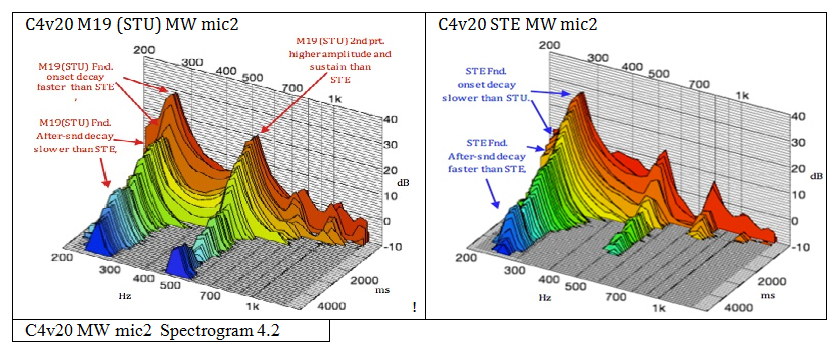
2. C4v20 MW mic2.Slower Fnd, a-s; 2nd prt. ; Earlier a-s transition.
 |
Stuart USB C4v20 M19(STU)MW mic2.wav |
Steinway C4v20 STE MW mic2.wav |
| Soundtable 4.5 C4v20 MW mic2 | ||
The brightness of the Stuart tone, and the roundness of the Steinway tone is illustrated at mic2, and in the mixed array sound. The 2nd partial is featured more prominently in the Stuart sound. The Steinway sound decays quickly within the first second of the sound, the later appearance of STE the 3rd partial is distinctive. The 3rd partial dominates the Steinway sound more than the Stuart sound. The Stuart sound sustains a consistent level till 7s, whereas the Steinway has sharp decays at 1s and 4s.
MW array sound:
| Stuart C4v20 M19 (STU) MW mxd.wav |
Steinway C4v20 STE mxd MW.wav |
| Soundtable 4.6 C4v20 MW mxd array | |
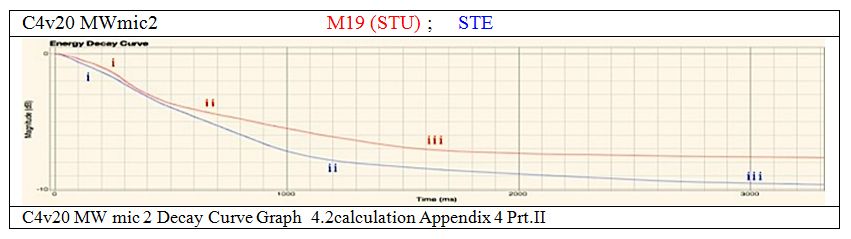
Decay:The Stuart moves into the 2nd phase of oscillation earlier, than Steinway by approximately .5s, losing less energy and maintaining a higher SPL and sustain.
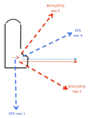 |
The Stuart sound of C4v20, is louder than Steinway at mic2. Steinway radiated waves of its maximum SPL to mics 1, & 4, the Stuart radiated waves of its maximum SPL to mics 2, & 5. C4v20 MW mic2 SPL:M19(STU) lp 81 leqA 59 STE lp 77 leqA 53 At the 4 probe positions, the Stuart soundboard vibrated at 75% greater magnitude than the Steinway soundboard for C4v20 The diameter of the Paulello/Stuart wire is .25mm thicker, the tensile strength of the Paulello/Stuart wire is 177 N/mm² higher, the Paulello/Stuart is 1.5mm longer, and is set at 3.5kg higher tension. The yield or capacity of the Roslau/Steinway wire is 3.6% higher than Paulello/Stuart. C4261. Hz Scaling, Soundboard table 4.2 |