sense that self growth is actively occurring. As much as it is a careful step, it is an exciting and thrilling step. I imagined the first footsteps out on the Menindee clay pans, the very first careful steps. The music in this movement repeats its melodic and harmonic language, though it changes key to present the same idea in a different colour of sound. The tones in First Steps are played in a fragile, careful manner.
The final movement of the Painted Piano Suite is Lines. The lines of musical pitch are played on the piano in stepwise diatonic rows, usually of five notes each. The damper pedal is fully engaged to hear the whole spectra of each row of notes. The rows transform into circular arpeggios and they ascend in pitch, signifying flight and freedom. (mm.28). The lines rise up as bright harmonic offshoots to eventually scatter in circular motifs. Four tonal centres are repeated throughout Lines . The musical lines move in various directions up, down, sideways and in a circular motion. Lines depicts growth in all directions.
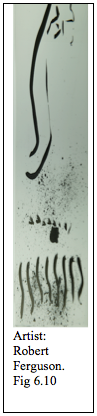
| Lines – The Painted Piano Suite |
| Score: Lines Appendix 8 p. 457 Audio Recording: Lines std.rec.wav |
| Audio visual table 6.11 |
Thank you to all the Menindee artists- Anthony Kelly, Travis Philp, Shane Blore, Naomi Vili, Leo Johnson, Jade Cicak, Taya Biggs, Bridget Malowe, Neil Mitchell, Mali Kelly, Riley Barnes, Joseph Newman, and their inspirational teacher, artist Rick Ball.
The collaborative creation of the Painted Piano and the participation of the Menindee community in OUR MUSIC linked the event with the thriving regional arts sector in regional Australia. Everyone who attended OUR MUSIC were witness to how the notion of the new Australian piano had inspired a community to interact with it artistically, even before they had seen it! The Menindee community’s artistry and musicality were on show that day in Sydney. They brought with them a great spirit of collaboration and creativity, amidst all logistical details of travelling long distances as a large group of all ages. They showed the city dwellers that anything is possible through their motivation.
The Indigenous and non-Indigenous music students collaborated in this same spirit. They produced an ensemble sound that is rarely heard in Australian music. The cross-cultural music I have composed
in the Yabun Yaguna collection was used to demonstrate to the music students, how these collaborations produce new sounds, new music. My collaborators are really co-authors of the Yabun Yaguna music because it was composed specifically for their collaboration with me. Richard Green, Clarence Slockee, Matthew Doyle, Marlene Cummins and Karen Smith have each contributed greatly to my collaborations with Indigenous music and culture.