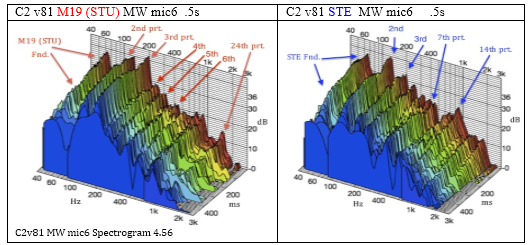
The Steinway sounded higher dB peaks of the 7th and 14th partials, than Stuart, both these partials produce the less than harmonious b7th interval, 1 & 2 octaves above the fundamental.
The higher dB peak and slower decay of the 24th partial of the Stuart, 1569.74Hz, (P5th pitch) is distinctive in this note C2v81mic6, below, as it was for C2v81mic2. The Stuart piano was 7dB louder than Steinway at mic6, and radiated higher SPL of Fnd., 3rd 4th, 5th, 9th and 24th partial frequencies.
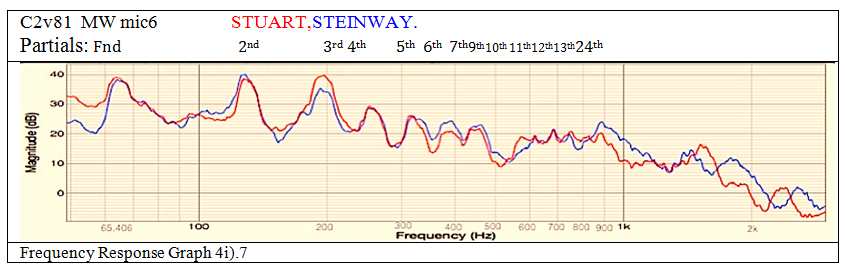
The Frequency Response graph above, shows the Steinway’s 2nd, 3rd, 10th and 13th partials had higher SPL than Stuart at v81. The Steinway line (blue) rises above the Stuart (red) line, in an interesting way
between 600 Hz and 1k.These higher peaks of dB of the higher partials, 9-10-11-12 -13-14, influence the brighter, brassier tone of the Steinway.
The onset rate of decay of the composite Stuart sound, was faster than the Steinway, the exponential decay being associated with its larger amplitude.248 At 3s, the Stuart rate of decay slowed for 1s, similar to the Stuart decay curve for the note C2v54 mic2. (See next page).
248Roederer, 122.