4.C4v81 MW mic1.
| Stuart C4v81 STU MW mic1.wav |
Steinway C4v81 STE MW mic1.wav |
| Sound table 4.30 | |
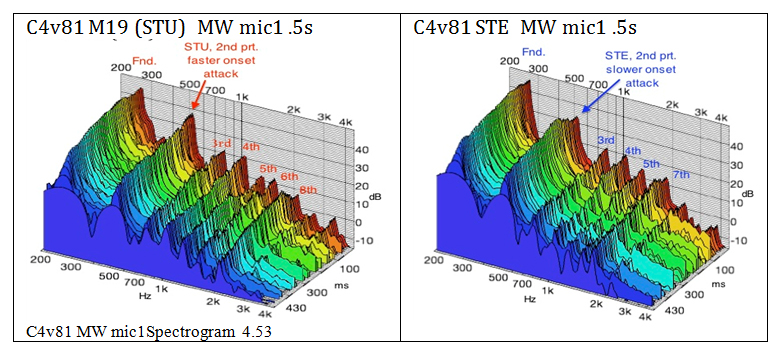
The Stuart 90dB, and Steinway 91dB, both radiated similar strong SPL levels of C4v81, to mic1. The Stuart sounds brighter. The number of upper partials illustrated in the .5s spectrogram below, are also similar for each sound, except the Stuart partials are more clearly defined, and the 8th prt of the Stuart and the 7th of the Steinway are more prominent. The high b7 in the Steinway is prominent in the sound, as is the high P5th in the Stuart sound. Generally the Stuart sound is more harmonically balanced, and harmonious. The Steinway tonal spectra, changes more frequently than Stuart’s. The Stuart at 90dB, and Steinway 91dB, both radiated strong SPL levels of C4v81, to mic1. The Stuart sounds brighter. The number of upper partials illustrated in the .5s spectrogram below, are also similar for each sound, except the Stuart partials are more clearly defined, and the 8th prt. of the Stuart and the 7th of the Steinway are more prominent. The high b7 in the Steinway is prominent in the sound, as is the high P5th in the Stuart sound. Generally the Stuart sound is more harmonically balanced, and harmonious. The Steinway tonal spectra changed more frequently than Stuart’s.
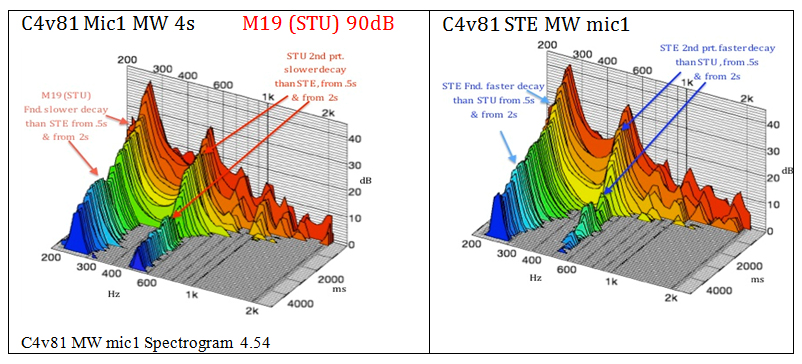
The main difference in the spectrums is the slower decay rates in the after-sound of the Fnd. and 2nd prt. Both the Fnd. and 2nd partials of the Stuart piano sound decayed at a slower rate than Steinway, between .5 and 2s.