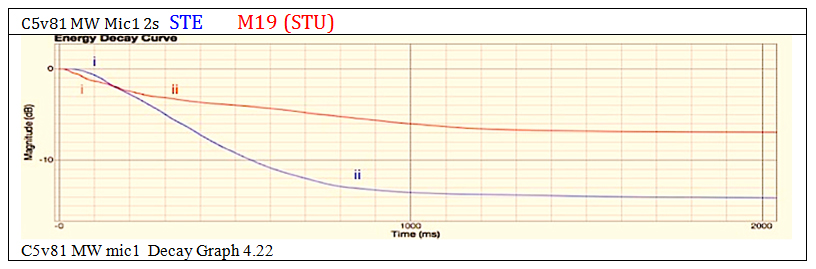
Wider Harmonic Spectrum, Stuart tonal distinction 3.
| Stuart C5v81 M19 (STU)MW mic1.wav |
Steinway C5v81 STE MW mic1.wav |
| Sound table 4.27 | |
1. C5v81 MW mic1.
The Stuart and Steinway radiated the sound of C5v81 at identical SPL of 86dB, to mic 1.
The Stuart tone is brighter, possibly due to the slower decay of the fundamental, enabling the wider spectra of the 2nd and 3rd partials, to be heard more openly, for a longer period. There is therefore a greater even sustain in the tonal balance in the onset and after-sound of the Stuart sound. In the 1st second of the Steinway sound, rapidly diminishing SPL output is heard, due to the more rapid decay of its fundamental frequency. This change in tonal and volume level is not heard in the Stuart sound. The 3rd partial is heard more prominently in the first 3 seconds of the Steinway sound, though is audibly more present for a longer period in the Stuart sound.
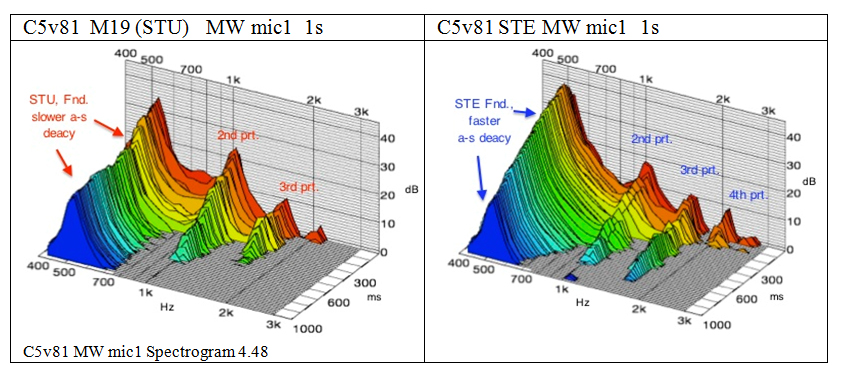
The sustained tonal balance in the Stuart sound is supported by the stability of the slowly decay rate of its fundamental frequency.
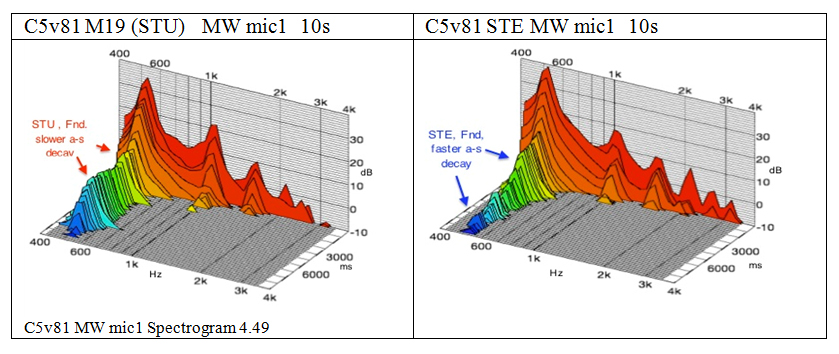
After a rapid decay and briefer onset oscillation period (i), the Stuart sound loses less energy , transferring to its 1st phase of settled steady-state oscillation (ii) , .5s earlier than Steinway.