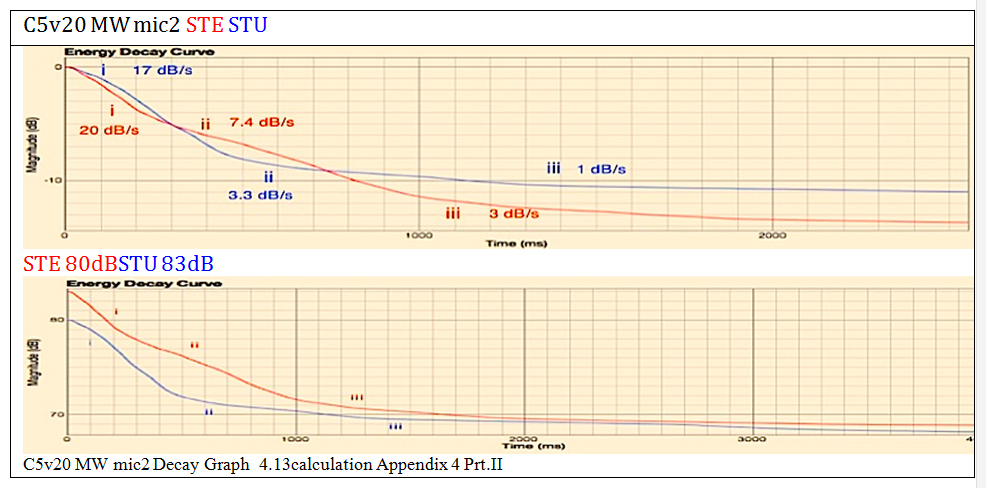
Earlier Transition to slower Oscillation,
Stuart Tonal Distinction 2.
 |
Stuart C5v20 STU MW mic 2 .wav |
Steinway C5v20 STE v20 MW mic 2.wav |
| Sound table 4.23 | ||
1. C5v20 MW mic2
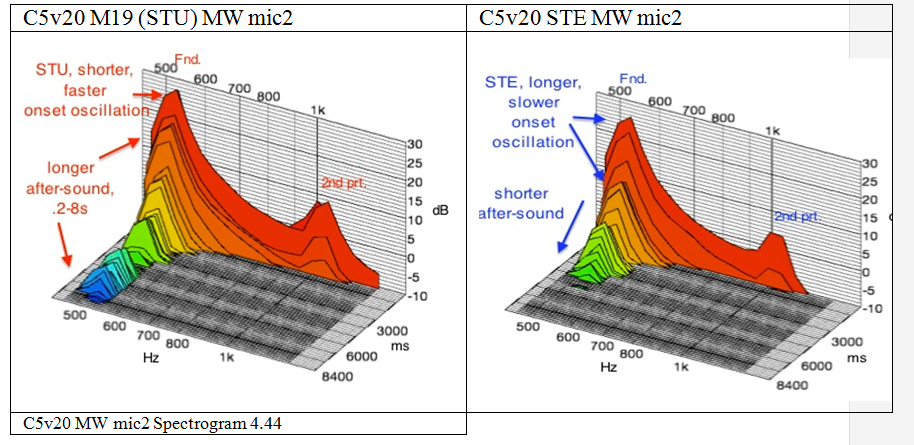
The Stuart sound is marginally louder than Steinway at mic2 by 3dB, and audibly the Stuart sustains its brighter tonal quality for a longer period than Steinway. The longer sustain is illustrated in the spectrogram. The higher amplitude of the 2nd partial frequency in the Stuart sound, influences the brighter sounding tone. At approximately 5s, the Stuart sound is audibly more present than Steinway.
The rapid onset decay in the Steinway sound (i) continues for .45s longer than Stuart.
The transition from the onset oscillation to the more steady after-sound oscillation occurs sooner in the Stuart sound, than in the Steinway sound. The larger amplitude of the Stuart fundamental (Fnd.) initially decays more rapidly to .2s, when t the transition to the slower oscillation and slower decay occurs, approximately .2s before the transition occurs in the Steinway sound.