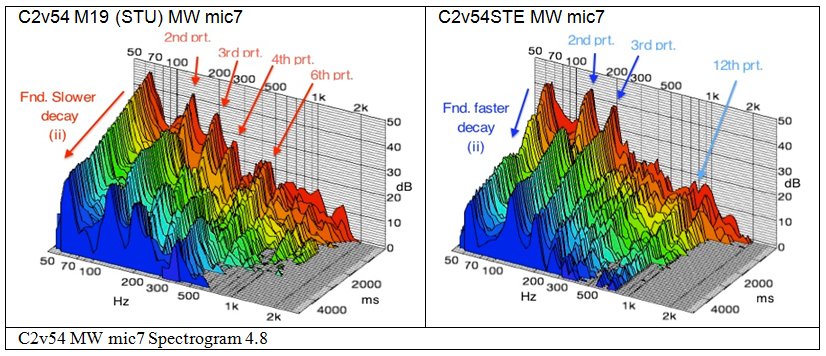
8. C2v54 MW mic7 – Slower Fnd. decay, Earlier transition; Wider Spectrum
| Stuart C2v54 STU MW mic7.wav |
Steinway C2v54 STE MW mic7.wav |
| Soundtable 4.17 C2v54 MW mic7 | |
The Steinway is 1 dB louder than Stuart at mic7 The Stuart sound contains a larger amount of bass frequency, i.e. more fundamental, and its more varied spectrum is ‘present’ from the beginning of the sound, whereas portions of the Steinway spectrum enter more gradually. The Steinway fundamental is decaying in a more fluctuating manner than the Stuart fundamental.

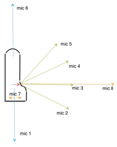
The Stuart is significantly louder than Steinway at each microphone of the 3 and 6 metre array.
In the 1st second of the array sound, the Steinway sound diminishes, as it did at mic7.
Array Sound:
| Stuart USB Audio 4.0 trk.49 C2v54 M19(STU) MWmxd.wav |
Steinway USB Audio 4.0 trk.50 C2v54 STE MW mxd.wav |
| Soundtable 4.18 C2v54 MW mxd array | |
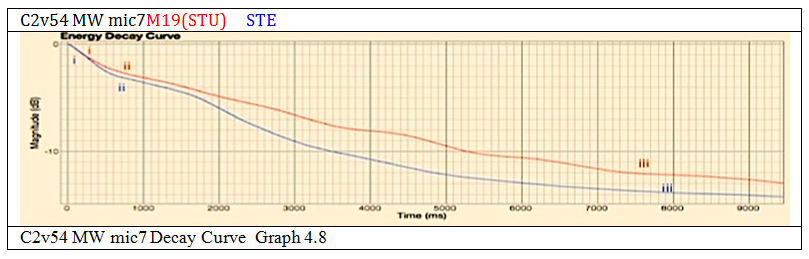
Decay:
Steinway’s shorter trichord of thinner strings loses more energy faster, than the Stuart bichord of longer thicker strings, of significantly greater tensile.
 |
For C2v54, the Stuart was louder than Steinway at mics 1,2,5,6,& 8 Soundboard: At the 4 probe positions, the Stuart soundboard vibrated at 44% greater magnitude than the Steinway soundboard for C2v54. STE S.board vibrated a larger fundamental than STU For the note C2, the diameter of the bichord Paulello/Stuart core wire is .125mm thicker than the trichord Roslau/Steinway wire, the cover wire is .47mm thicker and Stainless Steel, the tensile strength of the Paulello/Stuart wire is 481 N/mm² higher, the Paulello/Stuart is 235mm longer, and is set at 65.3kg higher tension. The yield or capacity of the Paulello/Stuart. wire is 46% higher than Paulello/Stuart. |
| C2 65. Hz Scaling, Soundboard table 4.8 | |