5. C5v81 MW mic8- Projection to 6 metres.
Slower Fundamental decay, Wider spectrum, Earlier a-s transition.
 |
Stuart C5v81 M19 (STU) MW mic8 .wav |
Steinway C5v81 STE MW mic8 .wav |
| Soundtable 4.11 C5v81 MW mic8 | ||
Radiating a distance of 6 metres both piano sounds are brighter in tone colour. The Stuart sound is brighter and louder. The partial movement in both sounds is fast and erratic.
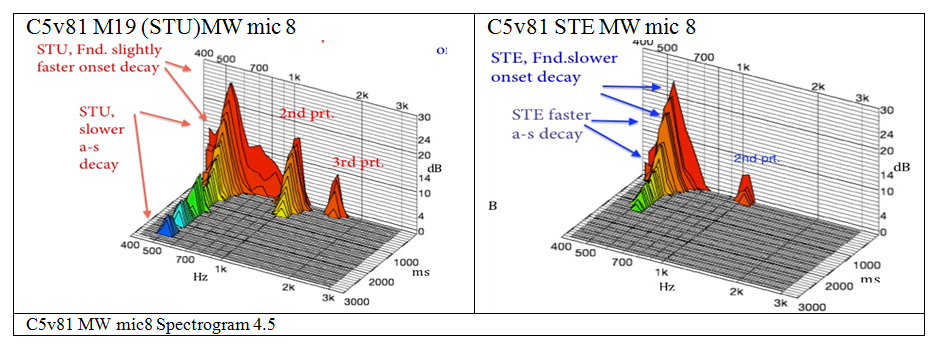
The Stuart was 7dB louder than Steinway at mic 8, at the velocity strike of v81.The attack sound is more present in the Stuart sound. After 1s the Steinway sound is heard to diminish in volume, far more rapidly than the Stuart sound.
MW array sound:
| Stuart C5v81 STU MW mxd array.wav |
Steinway C5v81 STE MW mxd array.wav |
| Soundtable 4.12 C5v81 MW mxd arry | |
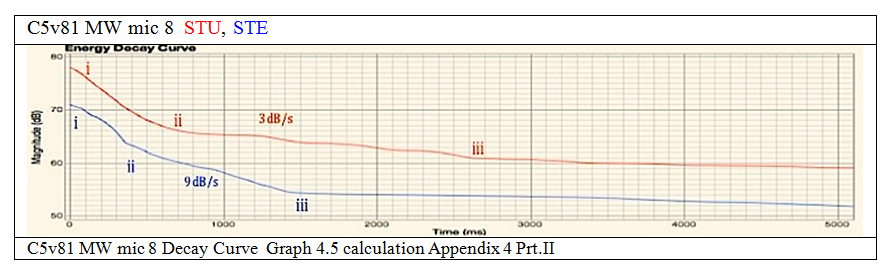
The onset of the Stuart sound (i) decayed slightly faster than Steinway in the onset of C5v81,
The Steinway (ii) transfers earlier than Stuart into its slower after-sound oscillation. The Stuart’s initial period of the after sound oscillation (ii) decays at ta slower rate than Steinway. The Steinway settles into its 2nd phase of after sound (iii) oscillation 1s earlier than Stuart.
Soundboard: The Steinway soundboard vibrated larger magnitudes of the fundamenta, 3rd, 4th , 5th& 6th partial frequencies than Stuart. The Stuart soundboard vibrated a larger 2nd partial frequency. The magnitude of the total movement of the Steinway soundboard was found to be 44% higher than the Stuart soundboard for C5v81
strength of the Paulello/Stuart wire is 138 N/mm² higher . The Paulello-Stuart wire for C5 is 4.5mm longer, and is set at 7kg higher tension. The yield or capacity of the Paulello-Stuart wire is approximately 10% higher than the Roslau-Steinway wire.