A wider spectrum.
4. C2v54 MW mic 6
 |
Stuart C2v54 M19(STU) MW mic6.wav |
Steinway C2v81 STE MW mic6.wav |
| Sound table 4.9 C2v54 MW mic6 | ||
The Stuart sound consists of partials with larger amplitudes, a more varied spectrum array and with slower rates of decay than in the Steinway sound. The fundamental, 5th and 6th partials are more clearly identified in the Stuart sound. The general tone of the Stuart note is more harmonious, emphasising the 6th partial, whereas the Steinway tone is more dissonant emphasising the 7th partial. The 6th partial was more resonant in the Stuart soundboard than in the Steinway soundboard.
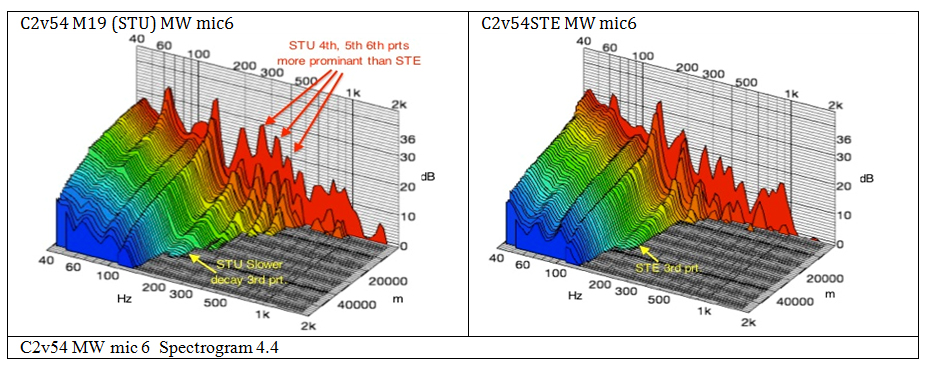
MW array sound:
There is more bass frequency in the Steinway array sound than solely at mic6.
The bass frequency of the Stuart sound in the array is quite large. The Stuart bichord sound is clearer, than the ‘whizz’ sound of the Steinway trichord.
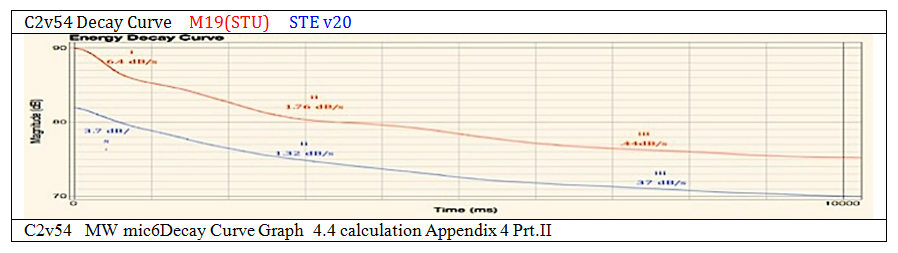
Decay: The Stuart decays faster than Steinway in its onset (i) and the 1st settled phase (ii).Slower than Steinway 3-4s.
| Stuart C2v54 M19(STU) MW mxd.wav |
Steinway C2v54 STE MW mxd.wav |
| Soundtable 4.10 C2v54 mxd array | |
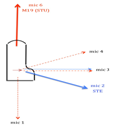 |
Stuart radiated waves of maximum SPL to mic6, and Steinway radiated waves of maximum SPL to mic 2. At mic 6, Stuart was 8dB louder than Steinway. C2v54 MW mic6 SPL:M19(STU) lp 90 leqA 62 // STE lp 82 leqA56. Soundboard: At the 4 probe positions, the Stuart soundboard vibrated at 44% greater magnitude than the Steinway soundboard for C2v54. The STE S.board vibrated a larger fundamental than M19(STU). For the note C2, the diameter of the Paulello/Stuart core wire is .125mm thicker, the cover wire is .47mm thicker and Stainless Steel, the tensile strength of the Paulello/Stuart wire is 481 N/mm² higher, the Paulello/Stuart is 235mm longer, and is set at 65.3kg higher tension. The yield or capacity of the Paulello/Stuart. wire is 46% higher than Steinway/Roslau. |
| C2 65. Hz Scaling, Soundboard table 4.4 | |