
3. C3v81MW mic5Slower after-sound Fnd., 2nd& 3rd prt. STE bass ‘swell’
Earlier transition to the after-sound oscillation.
 |
Stuart C3v81 M19(STU) MW mic5.wav |
Steinway C3v81 STE MW mic5.wav |
| Soundtable 4.7 C3v81 MW mic5 | ||
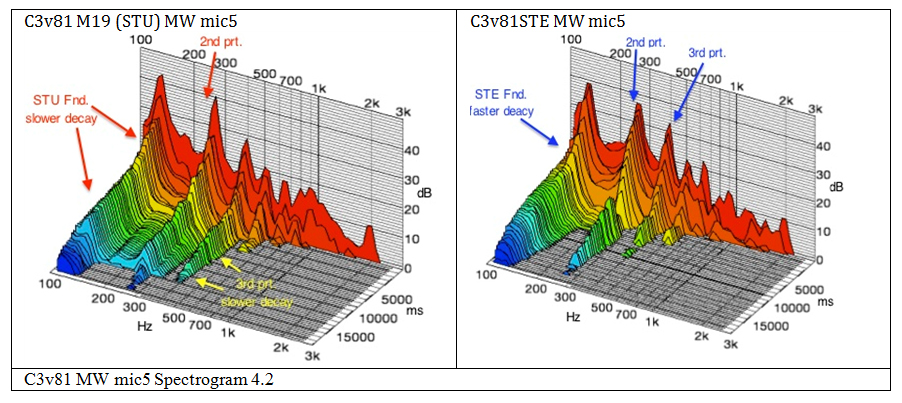
The Steinway sound produces a bass ‘boom’ at approximately .5s.We can see in the spectrogram that the Steinway Fnd. 2nd& 3rd prts are decaying at a slower rate than Stuart at .5s.Here we can hear the advantage of a faster decay in the onset, the Stuart has no bass ’swell’.
MW array sound:
| Stuart C3v81 M19 (STU) MW mxd .wav |
Steinway C3v81 STE MW mxd.wav |
| Soundtable 4.8 C3 v81 MW mxd array | |
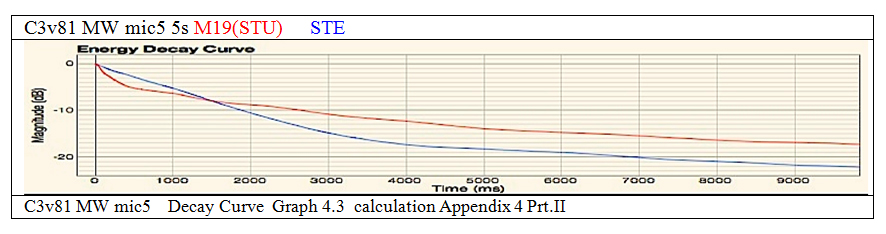
Decay: The Stuart moves into the 2nd phase of oscillation earlier, than Steinway by approximately .5s, losing less energy and maintaining a more sustain and higher SPL.
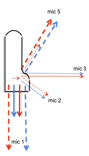 |
Both Stuart and Steinway radiated waves of maximum SPL to mics5 and 1. Both piano sounds produced similar levels of SPL lp, and STE had higher leqA by 3dB. C3v81 MW mic5 SPL:M19(STU) lp 90 leqA 64 // STE lp 90 leqA67 Soundboard: At the 4 probe positions, the Stuart soundboard vibrated at 19% greater magnitude than the Steinway soundboard for C3v81. For the note C3, the diameter of both wires is identical at 1.125mm. The tensile strength of the Paulello/Stuart wire is 140.5 N/mm² higher, the Roslau/Steinway is 41mm longer, and is set at 6.7kg higher tension. The yield or capacity of the Paulello/Stuart wire is 8% higher than Roslau/Steinway. |
| C3 121. Hz Scaling, Soundboard table 4.3 | |
