The ‘off set’is indicated by the yellow arrows in the photos below.
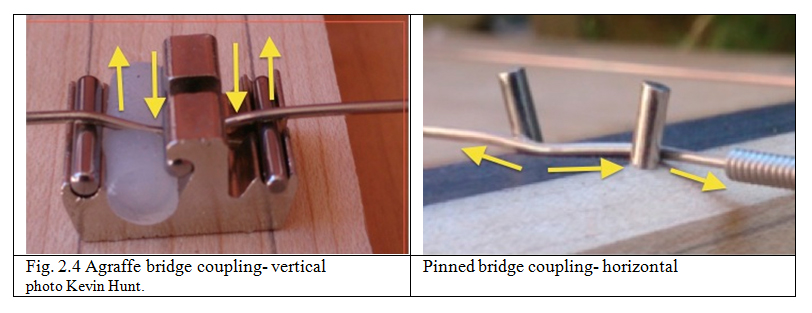
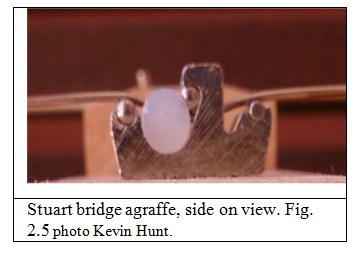
The string of the modern piano is pinned to the bridge in a two pinned horizontal ‘zig zag’ ‘off set’ plane, and the Stuart piano string is attached to the bridge in a vertical ‘zig zag’ ‘off set’ plane by the Stuart bridge agraffe .The horizontally pinned string is twisted in two zig-zag directions enforced by the two pins. The Stuart piano string is bent vertically in an up-down direction by the bridge agraffe.
The coupling of the string to the bridge is the fundamental connection between the string and the soundboard. The Stuart bridge agraffe couples the strings to the bridge maintaining the straight longitudinal line of the string by implementing a vertical twist termination replacing the traditional horizontal twist string termination coupling of the pinned bridge. The Stuart bridge agraffe has a three point coupling device through which the strings pass. The strings are bent at approximately 12 degrees to define the speaking length of each frequency unit. The Stuart agraffe is secured to the surface of the bridge. The three knife edges of the agraffe bends the wire whilst retaining the reaction forces produced by the string tension within the agraffe’s mass. This effectively neutralises the transfer of twisting and bucking forces to the soundboard.
The numerous vibrational modes of the oscillating string are transmitted into the bridge and soundboard via the agraffe on the Stuart piano, or via pinning on the modern piano. Some vibrations are transferred directly off the vibrating string to the soundboard and other panels on the piano, though these more longitudinal vibrations are less prominent in the onset sound, which carries the large portion of harmonic characteristics that influence the tonal colour of the sound. In 1977 Gabriel We in rich,the innovative researcher of piano string vibration and honoured doctor of physics and acoustics, defined piano string vibration as two separate vibrations, the initial vertical or onset