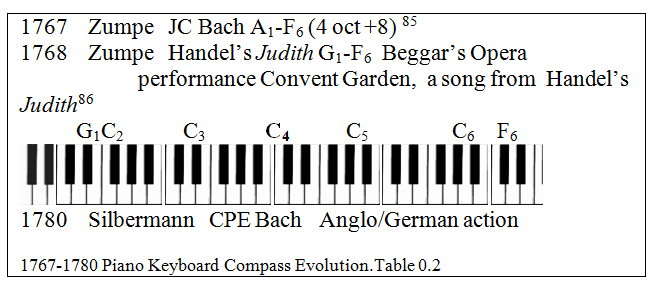
C.P.E. Bach was involved in the new musical style that focussed on the performer’s interpretation, taste and expression with a homogeneous melodic style, the stylegallant. The new musical expression had a sense of simplification, and attracted more amateur musicians to music performance than previously in the Baroque. As the piano progressively replaced the harpsichord as the preferred keyboard performance instrument, pianistic techniques, methods and ‘schools’ of playing began to be clearly illustrated by the leaders of the style in instructional volumes. The descriptions of piano tone, and articulations in these publications serve as an indication of which make of piano design was being favoured.
For nearly two centuries, piano designs changed as technical processes of steel drawing changed and the craft of pianist-composers in the late eighteenth and nineteenth centuries evolved.
The fact that instrument makers experimented so widely is evidence of new musical requirements which grew more insistent as the style of musical composition became increasingly homophonic, rather than contrapuntal.86
The pianist-composers, J.S Bach,CPE Bach, JC Bach, Haydn, Mozart , Beethoven, Schubert, Brahms, Schumann, Chopin and Liszt, Rachmaninov, Debussy and Ravel were in frequent contact with piano builders, and the virtuoso pianists such as Hummel, Clementi, Cramer, Moscheles, Thalberg, Hans von Bulow, Rubenstein, and Paderewski, had business and artistic involvement with the design developments and experiments of the piano makers such as Silberman, Stein, Broadwood, Graf, Pape, Collard, Erard, Peyel, Bosendorfer, Bechstein, Bluthner and Steinway.
85 5Good,. 58.
86 Arthur Ord-Hume, “Zumpe, Johann Christoph,” In 2Palmieri, Encyclopedia of the Piano, 451.
87 2Ehrlich,The Piano A History, 12.