This ebook thesis of six chapters contains embedded audio .wav files, visual .mov files.
The Audio and Visual resources are accessed by clicking on the blue print in the sound tables:
For example: The sound C5v54 STU MWmxd array.wav will be heard when clicked on.
| C5 v54 STU MW mxd array.wav |
| Soundtable 3.1 |
The note C5, is ‘C’ an octave above ‘middle C’, 523.25 Hz. The sound in the above sound table 3.1, is recorded by all the microphones in the room, the ‘mixed array’ of microphones.
Note Names:
The coding of the note names and their registers used in this research, spans a range of 8 octaves, for example for the note ‘C’ is denoted as C0 to C8. The octave numeral coding of each note is also notated in subscript font, for exampleC0 to C8. The numeral is not indicative of the harmonic relationship of the note to a key centre. In the illustration below, the numeral indicates the number of groups of 12 semitones above the note C0. ThereforeC8 indicates the note that iseight groups of 12 semitones (octaves) above C0.
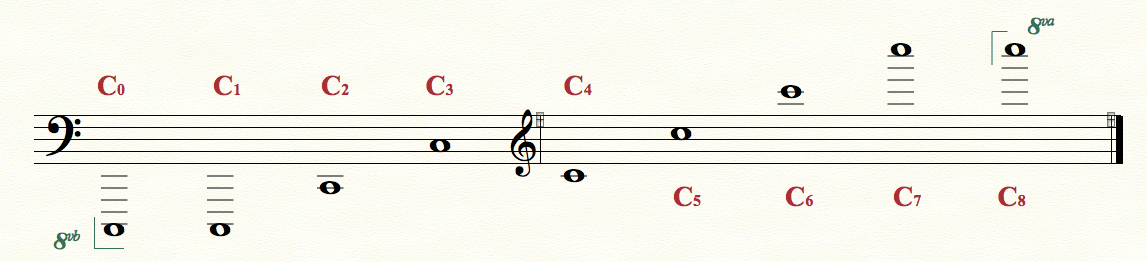
Keyboard compass chromatic spans of 11 semitones.
When describing the ambitus or compass of the piano keyboard ranges which extend above the standardised 88 keys of the modern piano, the term ‘chromatic span’ is used in this research. Chromatic spans denote the groups of 11 semitones above the given note, omitting a repeat of the given note. For example, the 102 key compass of the Stuart piano launched in 20101, has a compass range from C0 to F8. An11 semitone chromatic span which repeats 8 times, occurs above the notes C , C#, D, D# , E and F. The compass is therefore described having 8 chromatic spans for these 6 notes.
Scores- Appendix 8.
The Compositions and Collaborations are illustrated as music scores and presented in Appendix 8.
1See page 35